
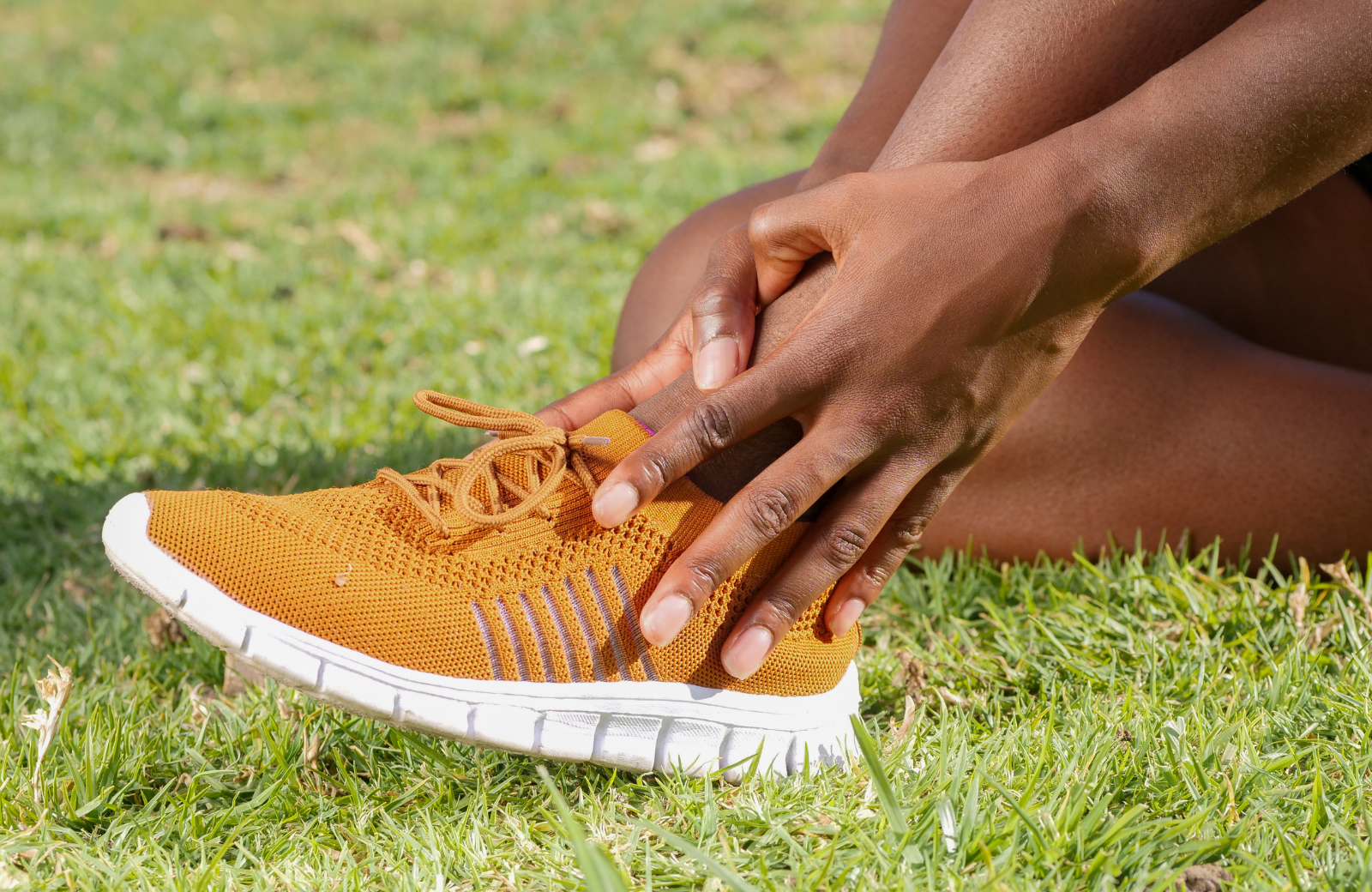
A high ankle sprain injures the ligaments that bind your two lower leg bones together above the ankle joint.
It heals more slowly than a common rolled ankle because those ligaments carry load every time your foot hits the ground.
You feel this injury above the ankle bone rather than on the outside of it. Pain shows up when you push off, twist, or walk up a slope.
Most people with a high ankle sprain recover fully without surgery. Recovery runs several weeks longer than a standard ankle sprain. Rushing that timeline is the fastest way to reinjure yourself.
What To Do In The First 48 Hours
Here is a short checklist you can act on today.
- Stop the activity that caused the pain and avoid testing the ankle by twisting it.
- Keep weight off the leg if walking makes the pain above your ankle sharper.
- Use compression and elevate the leg above heart level for short stretches through the day.
- Get imaging ruled in or out by a clinician if you cannot take four steps without severe pain.
- Book an assessment within a few days so you start guided loading instead of guessing.
What Is A High Ankle Sprain?
A high ankle sprain tears or stretches the syndesmotic ligaments. That tissue holds your tibia and fibula together just above the ankle. Clinicians also call it a syndesmotic injury.
Your ankle works like a hinge inside a socket. The tibia and fibula form that socket, and the syndesmosis keeps the two bones spaced correctly while you move.
When those ligaments tear, the socket loses a little of its stability. Every step then loads tissue that is trying to knit itself back together.
Where The Pain Shows Up
Pain sits above the ankle joint, often two or three finger widths up the outside of your shin. Some people also feel it along the front of the ankle where the two bones meet.
Swelling can look mild compared to a rolled ankle. That mismatch fools plenty of athletes into thinking the injury is minor.
How Is A High Ankle Sprain Different From A Regular Ankle Sprain?
The difference comes down to which ligaments tear and how the injury happened. A regular ankle sprain damages the ligaments on the outside of the ankle when your foot rolls inward.
According to the StatPearls clinical review of acute ankle sprain, roughly 70 percent of lateral sprains involve the anterior talofibular ligament. That ligament is the weakest and most commonly torn structure in the ankle. That same review notes that syndesmotic injuries are less frequent than lateral sprains but are often more severe.
Here is how the two compare.
| Feature | High Ankle Sprain | Lateral Ankle Sprain |
|---|---|---|
| Ligaments involved | Syndesmosis between tibia and fibula | Outer ankle ligaments, mostly the anterior talofibular ligament |
| Typical mechanism | Foot planted and leg rotates outward, or forced upward bend of the foot | Foot rolls inward under you |
| Where it hurts | Above the ankle joint, along the lower shin | On the outside of the ankle, below the bone |
| Swelling | Often modest early on | Often obvious and immediate |
| Painful movements | Push off, pivoting, walking uphill | Rolling the foot inward, side stepping |
| Typical recovery | Six to twelve weeks or longer | Two to six weeks for most grades |
What Causes A High Ankle Sprain?
Most high ankle sprains happen when your foot stays planted and your leg rotates outward over it. The twisting force pulls the tibia and fibula apart at the top of the ankle.
The StatPearls review describes the mechanism as dorsiflexion combined with external rotation. In plain terms, your toes point up while your shin turns away from the foot. Contact sports create that position constantly.
Sports Where We See It Most
- Hockey, where a skate blade locks the foot while a body check rotates the leg.
- Football and rugby, where a pile lands on a planted leg.
- Soccer and lacrosse, where a hard cut meets an opponent.
- Skiing and snowboarding, where a rigid boot holds the foot, and the body keeps turning.
- Basketball, where landing on another player twists the ankle sideways.
Why Some Ankles Are More Vulnerable
Previous ankle injuries leave behind stiffness and altered balance that raise your risk. Weak hip and calf strength also lets the leg collapse inward under load.
Footwear matters too. A boot or skate that locks the foot sends rotation straight into the ankle. The foot never gets a chance to absorb it.
What Are The Signs You Have A High Ankle Sprain?
The clearest sign is pain above the ankle joint that worsens when you push off or rotate. You may walk with a flat footed gait because rolling through the toes hurts.
Two clinical tests point toward this injury. Squeezing the calf below the knee reproduces pain at the ankle. Rotating the foot outward does the same.
Symptoms Worth Taking Seriously
- Pain that sits higher than a typical rolled ankle.
- Difficulty bearing weight for more than a day or two.
- Pain when you climb stairs or walk on a slope.
- A sense that the ankle feels loose or unreliable.
- Tenderness that runs up the outside of the shin toward the knee.
Tenderness high on the fibula deserves prompt imaging. That pattern can signal a fracture that travels up the leg.
How Long Does A High Ankle Sprain Take To Heal?
Most athletes return to sport six to twelve weeks after a high ankle sprain. Mild cases move faster. Severe injuries that need surgical stabilization take longer.
A 2022 systematic review and meta-analysis published in Foot and Ankle Orthopaedics pooled 1,133 syndesmotic sprains across 18 studies. The researchers reported an overall return-to-play rate of 99 percent, with a mean return of 52.32 days.
That same analysis found a mean of 39.33 days for athletes treated without surgery. Surgically treated athletes returned at a mean of 70.94 days. The authors also note that these injuries take more than twice as long as a standard lateral ankle sprain.
Here is a realistic timeline for a moderate high ankle sprain treated without surgery.
| Phase | Rough Timing | What You Work On |
|---|---|---|
| Protect and calm | Days 1 to 10 | Manage swelling, protect the joint, restore gentle motion, keep the hip and core active |
| Restore motion and load | Weeks 2 to 4 | Full weight bearing, calf and foot strength, balance work, normal walking pattern |
| Build strength | Weeks 4 to 7 | Heavier calf and hip loading, single leg control, light jogging when pain-free |
| Add speed and impact | Weeks 6 to 10 | Hopping, bounding, change of direction, sport-specific drills |
| Return to sport | Weeks 8 to 12 and beyond | Full contact, testing under fatigue, gradual minutes back in play |
Why The Range Is So Wide
Grade of injury drives most of the difference. A mild stretch of the ligament behaves very differently from a complete tear with joint widening.
Your sport matters as well. A runner loads the syndesmosis in a predictable line, while a hockey player loads it in every direction at speed.
Do You Need Surgery For A High Ankle Sprain?
Most high ankle sprains do not need surgery. Surgeons typically reserve it for injuries where the tibia and fibula separate, which imaging can confirm.
When the joint stays stable, guided rehabilitation works well. The meta-analysis above found high return-to-play rates in both groups. The non-surgical group returned sooner.
When A Surgical Opinion Makes Sense
- Imaging shows widening between the tibia and fibula.
- You cannot bear weight after several weeks of appropriate care.
- The ankle keeps giving way during simple movement.
- A fracture accompanies the ligament injury.
What Does Rehab For A High Ankle Sprain Look Like?
Good rehab moves through phases, and each phase earns the next. We progress you when your ankle tolerates load rather than when a calendar says so.
Early on we protect the joint and keep the rest of your body working. Sitting still for six weeks costs you fitness you then have to rebuild.
Phase One: Calm It Down
We manage swelling and restore comfortable motion at the ankle. Hands-on work helps the joint move without provoking the healing tissue.
You keep training your hips, core, and upper body throughout. That preserves the engine you need later.
Phase Two: Rebuild The Foundation
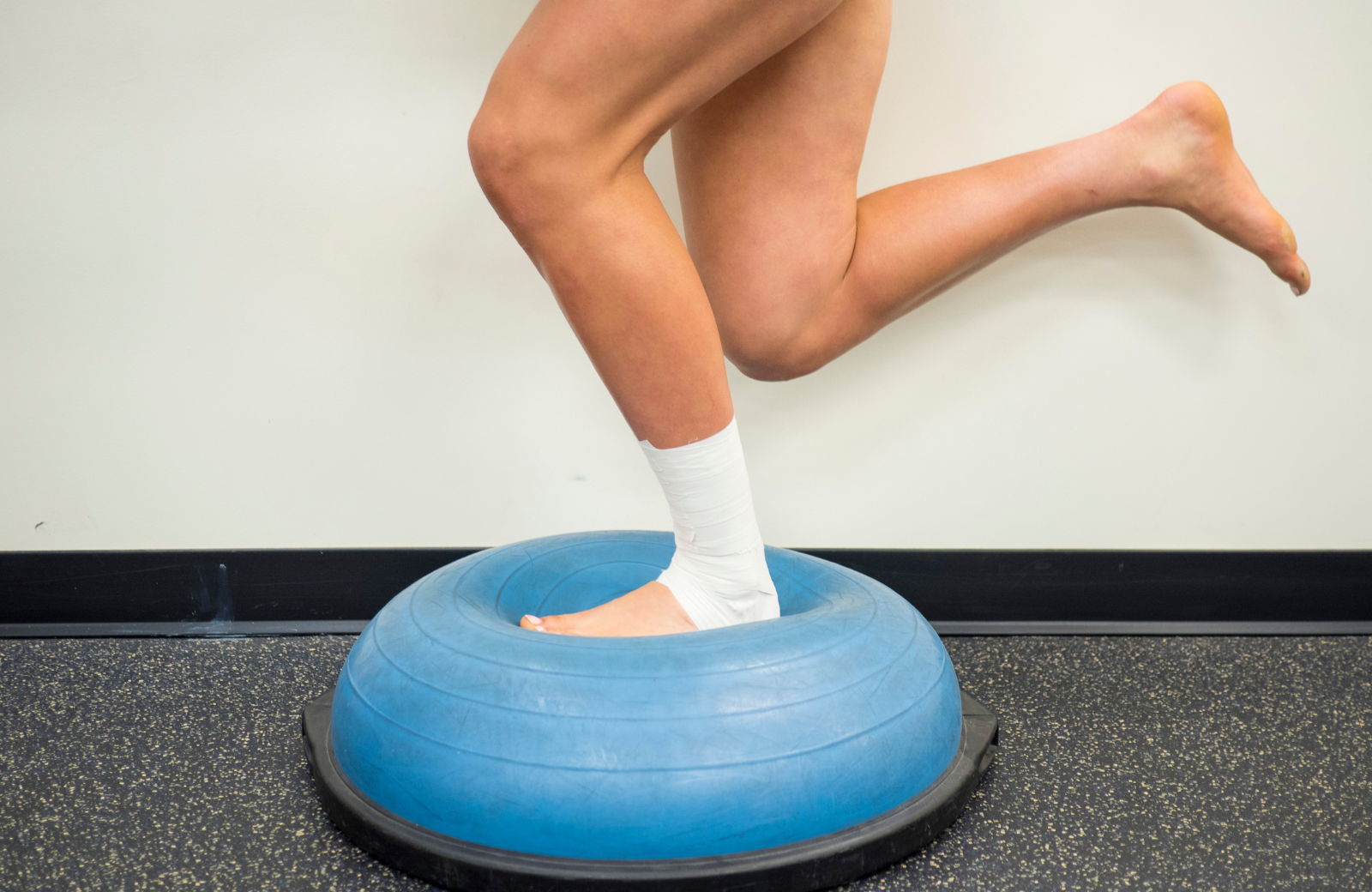
Calf strength sits at the center of this phase. Your calf controls how much force travels through the ankle every stride.
Balance work rebuilds the position sense that injury dulls. Single-leg stance progressions do more for reinjury risk than any brace.
Phase Three: Reload For Sport
Now we add speed, impact, and rotation in controlled doses. Hopping, cutting, and deceleration drills prepare the syndesmosis for real play.
We test under fatigue because that is when reinjury happens. A perfect hop test at minute one means little if it falls apart at minute twenty.
What We Do Differently
Every session at our clinic runs one-on-one with your Doctor of Physical Therapy for a full hour. No techs, no aides, and no bouncing between three patients at once.
That structure lets us reassess constantly and adjust the plan in real time. You can read more about our approach to sports rehab in Scripps Ranch.
How Do You Know You Are Ready To Return To Sport?

You are ready when the injured ankle performs close to the healthy one under sport-level demand. Pain-free walking is a starting point, not a finish line.
We look for objective markers before clearing you. Guesswork is how athletes end up back on the table.
Markers We Test
- Calf strength within roughly ten percent of the other side.
- Single-leg hop distance and control that match side to side.
- Full pain-free motion, especially bending the foot upward.
- Confident change of direction at full speed.
- No swelling response the day after a hard session.
Easing Back Into Play
Return happens in stages rather than all at once. Practice comes before games, and limited minutes come before a full workload.
We stay in contact through that ramp-up. Small adjustments during the first few weeks back prevent big setbacks later.
How Can You Lower Your Risk Of Another High Ankle Sprain?
Strength and balance training lowers your risk more than anything else. Ankles that control load in every direction handle awkward positions better.
Keep training after you feel fine. The tail end of rehab is where lasting protection gets built.
Habits Worth Keeping
- Two calf strength sessions a week, including straight and bent knee work.
- Regular single-leg balance practice on stable and unstable surfaces.
- Hip strength work so the leg does not collapse inward under load.
- Gradual increases in training volume rather than sudden jumps.
- Equipment checks, especially skate and boot fit.
Frequently Asked Questions
Can you walk on a high ankle sprain?
Many people can walk on a mild high ankle sprain, though it usually hurts when pushing off. Severe injuries often make weight-bearing very painful for the first week or two. Walking without pain does not rule out the injury, so get it assessed if pain sits above the ankle joint.
How do I know if my ankle sprain is high or low?
Location is the biggest clue. A high ankle sprain hurts above the ankle joint, while a low sprain hurts below the ankle bone. A high sprain also flares with twisting and push-off rather than rolling the foot inward. A clinician can confirm it with a squeeze test and an external rotation test.
Should you wear a boot for a high ankle sprain?
A walking boot helps in the early phase when the ankle needs protection from rotation. It is a short-term tool, not a treatment. Staying in it too long causes stiffness and calf weakness. Your clinician should give you a plan to wean out of it as symptoms settle.
Does a high ankle sprain show up on an X-ray?
An X-ray does not show ligaments. It can reveal a fracture or widening between the tibia and fibula that signals instability. Stress views or weight-bearing views sometimes reveal separation that a standard view misses. An MRI gives the clearest picture of the ligaments themselves.
Can a high ankle sprain heal on its own?
Stable high ankle sprains do heal without surgery, and the large majority of athletes return to sport. Healing on its own is not the same as healing well. Untreated cases often leave stiffness, weakness, and instability. Guided rehabilitation restores the strength and control that healing alone does not provide.
What happens if a high ankle sprain goes untreated?
Untreated syndesmotic injuries can lead to ongoing pain, chronic instability, and reduced motion at the ankle. Some people develop arthritis over time when the joint keeps moving abnormally. Early assessment and progressive loading greatly reduce those risks.
Getting You Back To What You Love
A high ankle sprain asks for patience, but it does not have to cost you your season or your training. The athletes who recover best are the ones who start guided loading early and progress on merit.
We treat active adults, runners, golfers, lifters, and hockey players across Scripps Ranch and San Diego. Our team is the preferred provider for the San Diego Sabers Jr. Hockey Team, so ankles like yours walk through our door often.
What Care With Us Looks Like
Your first visit is a full 60-minute assessment with your Doctor of Physical Therapy. We look at the whole chain from foot to hip, not just the sore spot.
Treatment starts on day one with hands-on work and a plan you can follow. You leave knowing what is wrong, what we are doing about it, and roughly how long it takes.
Support Between Visits
Your therapist responds within 24 hours when questions come up. Recovery does not pause between appointments, and neither do we.
We are also clear about cost from the start. No surprise bills, and no guessing about how many visits you need.
Built For Athletes Who Refuse To Sit Still
Our hockey injury recovery programs in Scripps Ranch handle exactly this kind of rotational ankle injury. The same framework works for skiers, footballers, and anyone whose sport twists a planted foot.
You keep training the parts of your body that are healthy while the ankle heals. That is how you come back fit rather than just pain free.
Talk To Us Today
Call us at 858 324 5537 to book an appointment or a free Discovery Call at our Scripps Ranch clinic. You can also request an appointment online, and we will reach out.
Not sure if physical therapy is right for your ankle? Ask for a Discovery Visit and see for yourself before committing to a plan.
Never Ever Stop Moving. Let us help you get back to what you love.